

In today's fast-paced business environment, effective supply chain management is more crucial than ever. Automation connectors play a vital role in streamlining processes, ensuring efficiency, and enhancing communication among various systems. Industry expert Dr. Emily Chen, a leading authority on supply chain automation, emphasizes, “The right automation connectors can transform a supply chain from reactive to proactive.” Her insight underscores the importance of choosing suitable connectors.
A well-implemented automation connector can bridge gaps between different platforms and applications. This integration leads to improved data visibility and better decision-making. However, many businesses underestimate the complexity involved. Issues may arise, such as mismatched data formats or delays in integration. Thus, selecting the right connector is not merely an operational task; it's a strategic decision.
The landscape of automation connectors is continuously evolving. Adapting to new technologies and changing demands is essential. While numerous solutions exist, some might not fully align with your needs. It's important to evaluate options carefully and seek expert consultations. A thoughtful approach will pave the way for enhanced supply chain efficiency and performance.

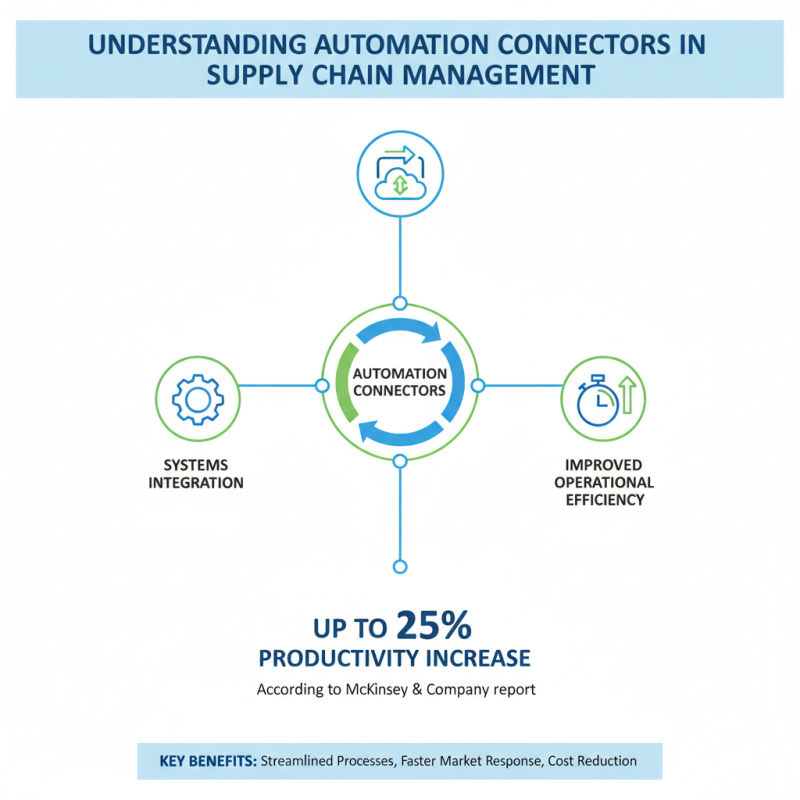
Automation connectors play a crucial role in streamlining supply chain management. By integrating various systems, these connectors enhance data flow and improve operational efficiency. According to a report by McKinsey & Company, effective automation can increase productivity by up to 25%. This significant boost helps businesses respond swiftly to market changes.
However, the choice of automation connectors requires careful consideration. Not all connectors are equally effective in different environments. Industry experts suggest that organizations assess compatibility with existing systems. A mismatch can lead to data silos and hinder performance, complicating processes rather than simplifying them.
Integration challenges persist. A survey by Gartner indicates that 70% of supply chain managers find integration with legacy systems to be a major obstacle. Identifying the right connectors is imperative to unlocking the full potential of automation in supply chains. Successful implementation can result in streamlined processes, but failure to adapt may create unnecessary complexity.

When selecting automation connectors for supply chain management, several key features stand out. Firstly, integration capabilities are vital. Connectors must easily interface with various systems, from inventory management to HR platforms. Real-time data exchange can improve decision-making and efficiency. Companies should prioritize connectors that facilitate seamless communication between software solutions.
Another feature to consider is scalability. As businesses grow, so do their supply chain needs. Connectors should accommodate increasing transaction volumes and support additional functionalities over time. Companies often underestimate this aspect. They might find their current solutions inadequate as their operations expand.
Usability cannot be ignored. A user-friendly interface ensures that team members can quickly adapt to new tools. Comprehensive documentation and support channels significantly enhance reliability. If the learning curve is too steep, organizations may struggle to implement these solutions effectively. Reviewing user experiences can reveal valuable insights into this aspect. By accounting for these considerations, businesses can make informed choices in their quest for efficient supply chain management.
In today's fast-paced business landscape, automation connectors play a crucial role in enhancing inventory management and optimization. According to industry reports, companies leveraging automation can see inventory turnover rates rise by 20-30%. These connectors streamline processes, reduce manual errors, and enhance visibility throughout the supply chain.
One effective strategy is to integrate real-time data monitoring systems. These systems allow businesses to track inventory levels continuously. This can lead to more accurate forecasting and reduced stockouts. A report from Logistics Management emphasizes that businesses could save up to 15% in inventory carrying costs with better visibility.
Tip: Consider utilizing predictive analytics to anticipate demand fluctuations. This can further optimize stock levels and improve service levels.
However, challenges remain. Some businesses struggle to adapt to new technologies. This can lead to misalignment between automation tools and existing processes. Continuous training is essential to ensure employees can effectively use these technologies.
Tip: Regularly evaluate the effectiveness of your automation tools. Collect feedback from staff to identify any gaps in the integration process.
Integrating automation connectors into existing supply chain systems can transform efficiency. Automation minimizes manual tasks, cutting down errors. When systems communicate seamlessly, data flows smoothly between them. This is essential for real-time decision-making. Supply chains are intricate, involving multiple parts and processes. Automation reduces complexity, but it also requires careful planning.
Challenges arise when integrating automation connectors. Existing systems may not easily accept new connectors. Compatibility issues can lead to frustrations. It's crucial to assess your current infrastructure first. Identify gaps that automation can fill. Test integrations in isolated environments before full deployment. Monitoring and adjusting connectors is necessary to keep everything aligned.
Investing in automation is a journey. Every organization has unique needs and structures. Patience is key, as results won’t appear overnight. Engage stakeholders early in the process. Solicit their insights to find the best solutions. This collaboration can ease the transition and improve acceptance. Embrace the imperfections in the process; they often lead to valuable insights.
| Connector Name | Integration Type | Key Features | Compatibility | User Rating |
|---|---|---|---|---|
| Smart Inventory Connector | API | Real-time stock updates, low stock alerts | ERP Systems, E-commerce Platforms | 4.7/5 |
| Order Fulfillment Connector | Webhooks | Automated order tracking, shipping status updates | Shipping Carriers, Order Management Systems | 4.5/5 |
| Supplier Management Connector | REST API | Supplier performance tracking, document management | Supplier Portals, ERP | 4.6/5 |
| Financial Reconciliation Connector | API | Automated invoice matching, financial reporting | Accounting Systems, ERP | 4.8/5 |
| Warehouse Management Connector | Web API | Inventory optimization, order routing | WMS, ERP | 4.4/5 |
| Logistics Optimization Connector | APIs | Route optimization, cost analysis | Logistics Platforms, ERP | 4.6/5 |
| Customer Feedback Connector | Webhooks | Automated feedback collection, sentiment analysis | CRM Systems, E-commerce Platforms | 4.5/5 |
| Product Lifecycle Connector | API | Lifecycle tracking, compliance management | PLM Systems, ERP | 4.7/5 |
| Demand Planning Connector | REST API | Forecasting tools, analytics integration | Analytics Platforms, ERP | 4.8/5 |
Automation connectors play a crucial role in supply chain management. Many companies have successfully implemented these tools to enhance efficiency. For instance, a recent report by the Supply Chain Management Review indicates that businesses utilizing automation connectors have seen productivity increases of up to 30%. These connectors streamline communication across various platforms, reducing time spent on manual tasks.
A case study highlights a mid-sized manufacturer that adopted automation technology. Prior to implementation, they struggled with order tracking. Their process was often delayed, leading to customer dissatisfaction. After integrating automation connectors, they improved order processing speed by 25%. This change not only satisfied customers but also reduced operational costs significantly.
However, the transition is not without its challenges. Some businesses report difficulties in interoperability between existing systems and new automation tools. There is also the need for skilled personnel to manage these technologies efficiently. Despite these hurdles, the overall benefits illustrate a promising pathway for future supply chain improvements.
This bar chart illustrates the efficiency improvements achieved through the implementation of automation connectors in supply chain management. The data reflects the percentage increase in efficiency for various categories: